


Ashleigh Peterson has podiumed in the elite field at a Spartan Ultra. She has also finished dead last. Ahead of Lake's Entrance, she walks us through how to actually train for 50km and 60 obstacles.
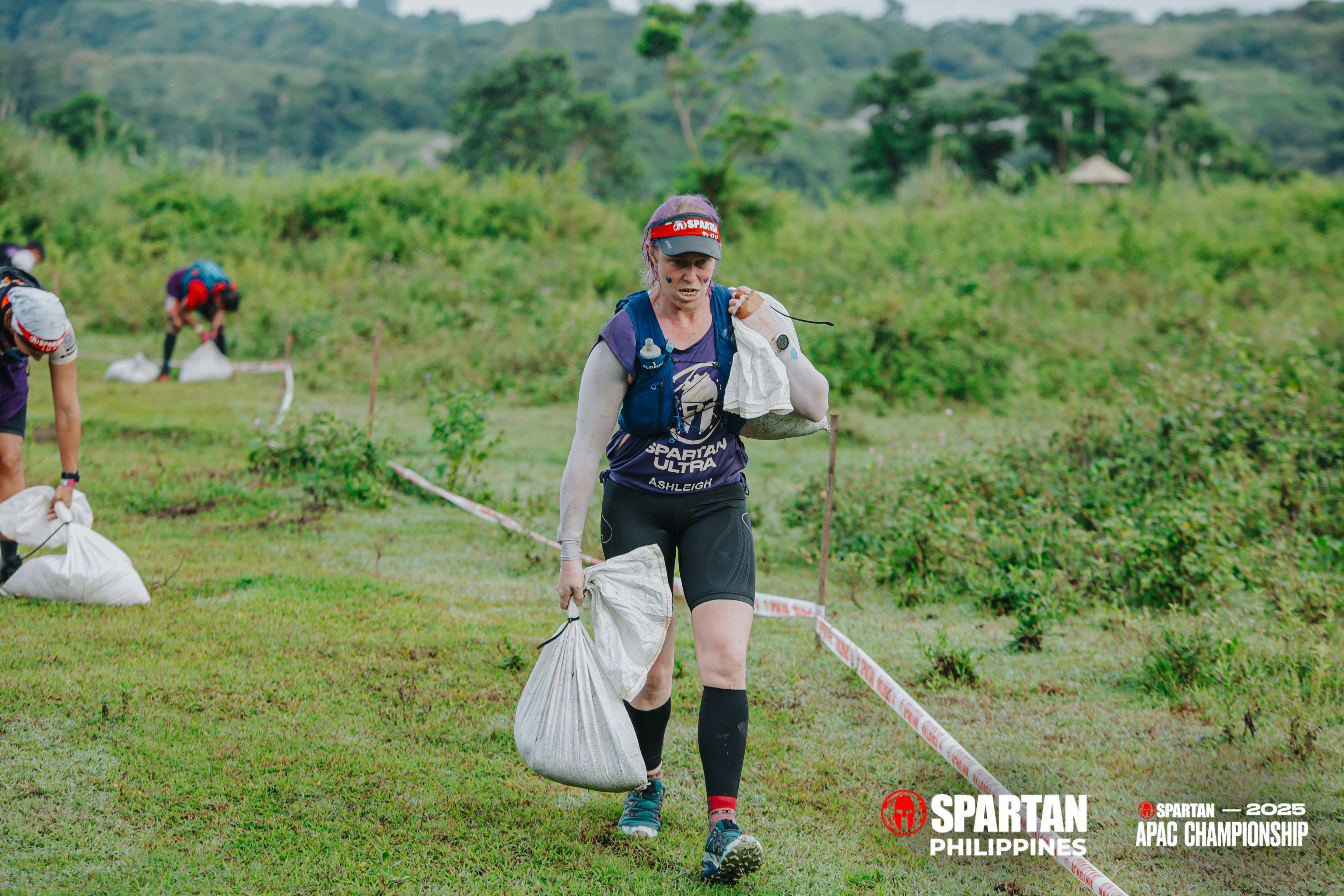
There is a particular kind of confidence that gets people into trouble at a Spartan Ultra, and Ashleigh Peterson hears it all the time.
"I hear it from people who have run 30km or more with no obstacles," she says. "They think they will be able to complete a Spartan Ultra without changing their race plan. They say I have run this far in this time, so I should be able to do this comfortably. Then they find their bodies are unprepared for the increased toll that the obstacles take."
Peterson would know. She has finished eight Spartan Ultras since 2020: Gold Coast, Bright, Fiji twice, Ivory's Rock, Porac in the Philippines for the APAC championship, and Morzine in France for the Ultra World Championships in both 2025 and 2026. She added an 80km trail ultra at Noosa this year for good measure. She is the 2026 Spartan Australia Team Captain.
She is also, by her own account, someone who has come last.
With the Lake's Entrance Ultra Trifecta Weekend now open, we asked her the questions people actually want answered.
You do not need to run 50km to run 50km
The first thing Peterson wants to clear up is the long run, because most people either overdo it or avoid it entirely.
"You absolutely do not need to be training to do 50km," she says. "I would do my longest run between 35 and 40km."
The build to get there is unremarkable on purpose. Increase your training by roughly ten per cent each week. That is the progression. There is no secret in it.
Ideally, she says, you arrive at the start of a build already able to run 15 to 20km comfortably, with a mix of four to six runs and gym sessions in a week. But she is realistic about what most people can commit to.
"It can be hard to find the time. I would say no less than three runs a week."
Three. If you have a job and a family and a build that is eleven weeks long, that is the honest floor.
Grip is what actually ends people's day
Fifty kilometres is the number on the poster. Sixty obstacles is the number that decides your race.
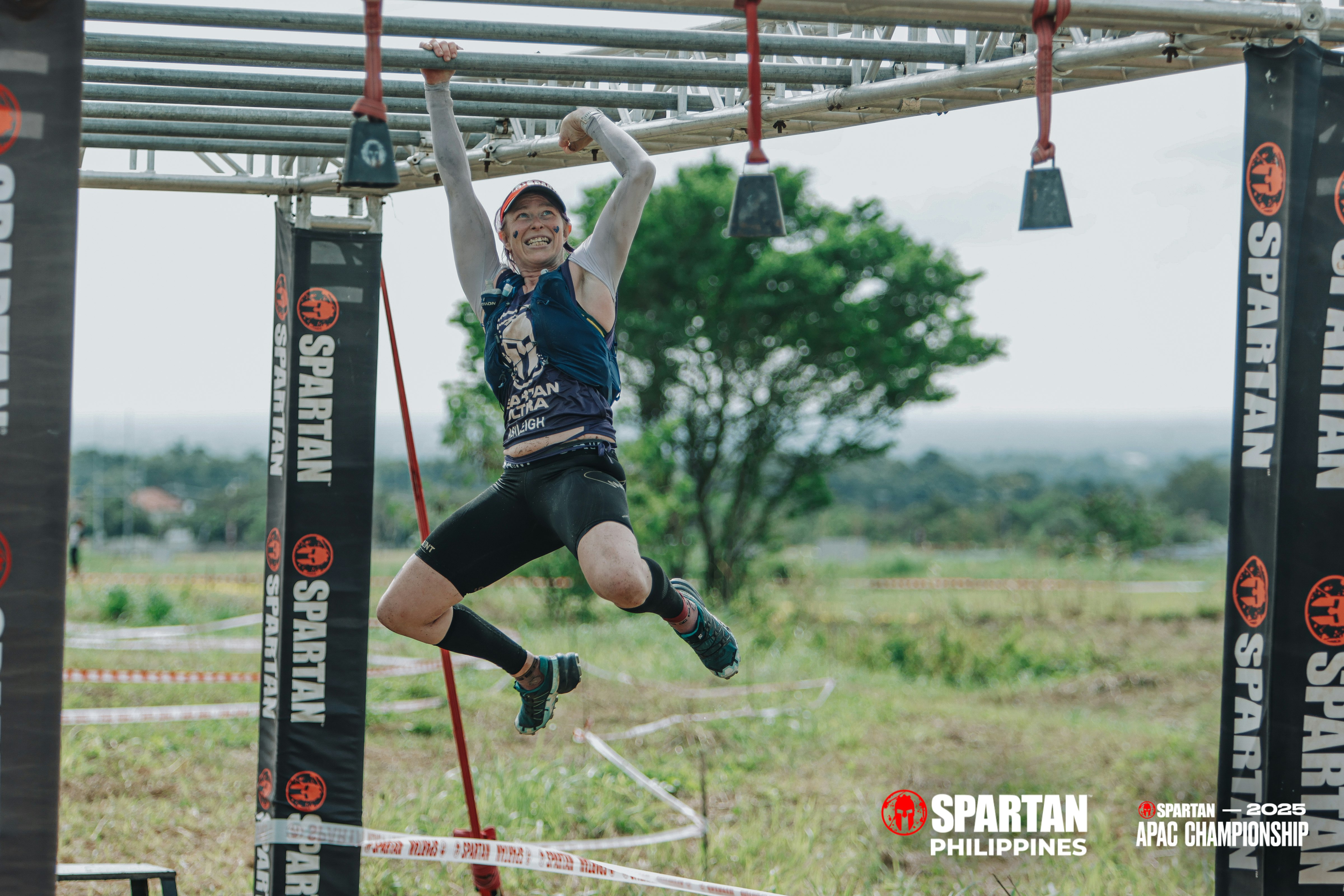
"Any of the hanging obstacles that are thrown into the last 5km," Peterson says, when asked what wrecks the most people late. "Our arms hurt, our grip is pushed to the limit, and many times it comes down to holding on with sheer willpower."
Her answer to that is not a dedicated grip day. It is a few minutes bolted onto the end of everything else.
Farmers carry at the heaviest weight she can handle, roughly 100m
Dead hangs from a pull-up bar, four sets of thirty seconds
Dead hangs while switching her grip around, to simulate moving across a hanging obstacle, four sets of thirty seconds
Every workout. A few minutes. That is it.
There is one more thing she trains that road runners almost never think about. "Balance and ankle mobility. Those trails can be quite technical at times, and road runners are often unprepared for the unstable terrain."
Burpees, at a pace you can hold
Burpee penalties add up across 60 obstacles. Peterson's strategy is the opposite of what instinct tells you to do.
"No matter if I am on my first burpee or my ninetieth, I will never try to smash them out. I always approach my burpee penalties with a steady, consistent pace. Why smash out the first ten in thirty seconds, only for it to take you three minutes to finish the rest?"
Fuelling, from someone who is bad at eating
Peterson is upfront that nutrition is her weak spot. "I am a weird one with nutrition, I struggle to eat on race day."
What she carries: electrolyte sachets, juice-based gels, a cramp preventative, and Canadian maple syrup.
What she starts with: one litre of electrolytes and one and a half litres of water. She deliberately carries more than she needs, and rotates between the two by intuition, rather than following a schedule.
The week before is carbohydrates. Race morning is coffee and fruit puree baby food, which is less strange than it sounds when your stomach has closed for business at 5am.
What went wrong: "Eating bananas. Some people swear by them, but it made me feel terrible."
Her drop box at transition is its own piece of planning: spare soft flasks pre-mixed with electrolytes for a fast swap, water to refill the bladder, replacement gels and syrup and cramp fix, baby food, trail mix, bandaids and tape, and one item she will defend to anyone.
"Coke. It is a miracle drink during transition."
The low point arrives earlier than you think
Ask most people where an ultra gets hard and they will point at the back half. Peterson's answer is the opposite, and it might be the single most useful thing in this guide for a first-timer.
"Funnily enough, I struggle the most at the start, roughly between the seventh and eighth kilometre. I am an endurance-minded person and often I will not find my running groove until close to the 20km mark. During those moments I just put one foot in front of the other and keep moving forward. I will not find my groove if I stop 10km in."
So if you fall apart at 8km, you are not failing. You are exactly where Ashleigh finds herself.
What she does with her head while she waits for it to pass is deliberately boring. "I do mental maths. Calculating what my average pace should be to finish in my desired time, calculating what time I should reach certain points. I do not do this to actually push for the times, I do it just to distract myself. If I keep my mind active, my body will follow."
Cold is the thing that has come closest to breaking her. At Morzine this year the course included a lake swim, and the weather was not warm enough for her clothes to dry.
"It changed my mentality from I am going to crush this race, to I do not know how I am going to keep going. But at the end of the day, I knew I would regret it with every fibre of my being if I did not keep pushing."
The maths that gets you home
Here is the piece of race craft she offers that nobody tells first-timers.
"Remember how much time you have and how far you have come. In Australia the first lap of an ultra is usually around 29 to 30km. After you leave transition, you only have 21km to go. If you can make transition, you can finish the ultra."
Twenty-one kilometres. A distance that would have sounded enormous a year ago, and now sounds like the easy part. That reframe is the whole back half.
"Just remember, no matter how tired you may be, never stop moving."
Lake's Entrance, specifically
Peterson has not raced Lake's Entrance. She is used to bush and mountains, and this one is coastal venue with mixed terrain.
"Sand is totally new ground for me and I am honestly not looking forward to it. Train your calves, people."
"My strategy for multi-day events is to pick one event that will be used as a cruisy training run. One distance that you will not push yourself to the limit on. For me it is the Super. The Ultra is the big one. You do not want to burn yourself out before you stand on that start line."
Her single piece of kit advice for a coastal venue in November is the least surprising thing she said all interview, and the most emphatic.
"Good trail shoes. I have run over 75 Spartan events in the same type of shoe. They drain well, dry quick, and have amazing grip."
Who actually finishes a Spartan Ultra
This is where people decide the Ultra is not for them, so we asked her directly. Someone reads 50km and 60 obstacles, decides they would be last, and closes the tab.
"I have run eight Spartan Ultras. I have achieved a podium finish in the elites, but I have also come last overall. In fact, three of my Spartan Ultras have taken me over thirteen hours."
"The Ultra is a proving ground for no one but yourself. Yes, it can be competitive against other people, but it can also be a way to prove that you are better than you were before. I have also met some of the most amazing people at the back of the pack, where we forget about speed and just run with each other to make sure we all cross that finish line."
The field, in her description, is not what the highlight reel suggests. "Ultra finishers come in all shapes, sizes and genders. The single defining feature of an ultra runner is their inner strength and self-belief."
And on the practical question of how much of the day is actually running: "There is a combination of walking and running. I find my best strategy is to run all the flats and downhills, but I will walk the uphills to conserve energy. And honestly, because I suck at running uphill."
What finishing changed
Peterson's first ultra did not change her. Her second one did.
"I went into my first ultra with training and planning. My second ultra, at Bright in 2022, I stood at the start line after eighteen months of struggling to get out of bed, let alone actually training. When I crossed that finish line, I realised that my story was not done yet, and that my journey had only just begun. I realised how much strength I still had, and what I would lose if I let myself go."
"It is not an understatement for me to say that my first ultra opened a doorway to a new challenge, but finishing my second ultra at Spartan saved my life."
If you are doing it tough, support is available. Lifeline is on 13 11 14, 24 hours a day.
Stop waiting until you are fitter
We finished with the objection that stops more registrations than price ever has: I will do it next year, when I am fitter.
"There is no time like the present," she says. "If a Spartan is waiting until they are fitter, they risk setting a goalpost that will forever be out of reach. No matter which ultra you want to race, stop sitting on the fence and book that ticket. Once you have the ticket, you have a set goal, a set timeframe and an achievable target."
"Do not let your opportunity pass by because you are not sure about the result. Take the chance and see what happens. Your Spartan community will be here to support you every step of the way."
The Lake's Entrance Ultra Trifecta Weekend runs 21 to 22 November 2026. Ultra entries are open now, and Spartan Pay lets you lock in your price with a deposit and pay the rest in installments.
REGISTER NOW
Ashleigh Peterson is the 2026 Spartan Australia Team Captain. Follow her at @run.bake.mum.
This guide reflects one athlete's personal experience and is not individual coaching advice. Build your training gradually, and speak to a doctor before starting a new endurance program.


